Frequently Asked Questions

On this page, you will find FAQs on:
General Union FAQs
-
A union is a group of workers who join together to improve their workplace. Our union is us! Having a Union gives us the power to collectively bargain with management over wages, benefits, and working conditions - we will have a democratic voice in our workplace.
-
We are organizing a Union at Healthy Living because we love our job and co-workers and want to make Healthy Living a better company for everyone. With a union, we will have the right to negotiate a contract and have a greater say in workplace policies, benefits, and pay. We hope to address issues like seniority pay, company-wide software, communication with upper management, scheduling, staffing, fair disciplinary procedures, and more.
-
Workers United, Upstate New York and Vermont, is a union which is generally recognized as one of the most successful organizing unions today given their efforts with the highly publicized Starbucks and Ben & Jerry’s campaigns. The regional union is based in Rochester, NY and represents workers from many different industries, including dining halls, grocery stores, and coffee shops. Workers United is a division of SEIU, a union that represents over 2 million members across the nation.
-
An organizing committee is the group of workers that help lead the union campaign. The committee is a voluntary group of Healthy Living workers who have shown interest in organizing. Anyone who wants to get more involved with the union is welcome to join the organizing committee; it is never too late to get involved!
-
We won our union election on May 1! We are currently in the process of drafting contract proposals.
-
Signing a union authorization card means that you support a union at Healthy Living. Every worker has the right to sign a union card or not! Management will NOT know who does sign, or does not, sign a union card. Union cards are ANONYMOUS to management. It is illegal for management to ask if you have signed a union support card, how you plan to vote, or whether you support the union.
-
Our working conditions impact our ability to help our customers. By improving staffing ratios, improving training standards, and elevating safety protocols, we can ensure that Healthy Living is a high-quality shop for our customers to patronize. By improving compensation, benefits, and break time for employees, we can ensure that Healthy Living is a sustainable place to start a career. When we’re less burnt out, it’s easier to provide the high-quality service that our customers deserve.
-
We are organizing what’s called a ‘wall-to-wall’ unit, meaning that all non-managerial Healthy Living workers may be eligible to join the union. This is important: just because your job has the word “manager” or “supervisor” in the title, does not mean that you are necessarily a manager. The National Labor Relations Board has specific criteria for how they define managers. If you are unsure if you’re considered a manager, feel free to connect with someone on the organizing committee.
Currently, we have organizing committees at all three Healthy Living locations (South Burlington, Williston and Saratoga). Our hope is that we can form a union that includes all Healthy Living workers to make our Union the strongest it can be and make working conditions better for all Healthy Living employees.
-
Yes, and unfortunately our concerns are not always heard or taken seriously. Unionizing will ensure that the owners collaborate with us in good faith to resolve issues, instead of ignoring feedback and making unilateral decisions. And the solutions we agree to will be enforceable and in writing, meaning they can’t be reversed.
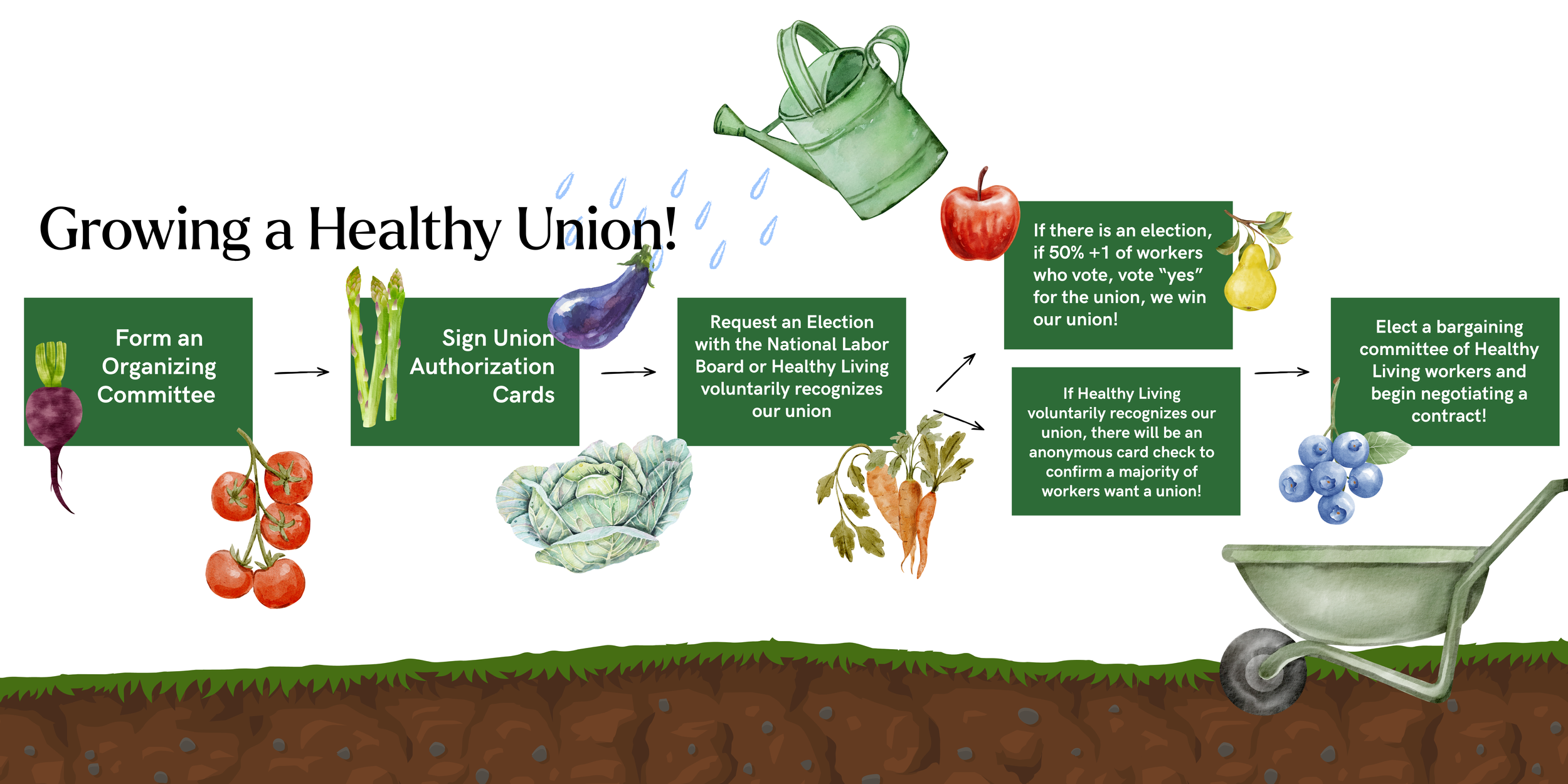
FAQs on the Collective Bargaining Process
-
A Collective Bargaining Agreement (CBA) is a contract that is negotiated between the workers and owners of Healthy Living. It sets the standard for wages and working conditions at our store, sort of like an employee handbook except that we get to help write it and it’s legally binding. - but one that we help write.
-
We do! CBAs are bargained by a bargaining committee made up of Healthy Living staff. The bargaining committee writes the contract proposals based on feedback they gather from their coworkers. They present these proposals to management in bargaining sessions where they work with the owners to come to an agreement. Once the workers on the committee have reached a tentative agreement with management, all Healthy Living workers will have the opportunity to vote on the contract, which only goes into effect with majority approval.
-
Besides pay and benefits, we can also bargain over policies and practices that are important to us! For example, we can bargain over things like: staffing ratios, seniority raises, disciplinary processes, breaks, schedules, health and safety policies, etc.
-
No. A union contract will set the standards for our workplace and a process for resolving issues through dialogue with management. It also gives us the option of using resources from Workers United to help out with resolving those problems if we need to. We still have every right, and are encouraged, to talk about issues directly with our managers. What our contract will ensure is that there are clear mutual standards for how our store will operate.
Sometimes management will tell workers that a contract makes your job less flexible. Since the content of our contract is up to us, we get to decide how flexible we want the rules to be. If we want to maintain flexibility in scheduling or leaves of absence, for instance, we can put that in our contract. On the other hand, if we want to make the minimum starting rate a firm standard, we can do that too.
-
As “at will” employees, we can currently be fired at any time for any reason or no reason at all (as long as the reason isn’t discriminatory). With a union contract, we can implement a “Just Cause” for discipline provision which means we can only be reprimanded for a proven and fair reason. With Just Cause, management must follow due process and progressive discipline standards. This does not mean that workers cannot be disciplined – only that it must be done fairly and with equal standards and expectations for everyone.
-
Typical first contract negotiations range from four to six months. The speed at which we negotiate a contract will depend on how many workers are in the union, how management responds to our proposals, and the ability for us to foster an active membership.
-
After a contract is ratified, we will elect union stewards to represent our interests in the workplace and ensure that the contract is being followed. We will work to build a strong, democratic union that fosters equity, community, and solidarity with all Healthy Living workers. We will also have a union representative from Workers United to assist if there are grievances or issues that need additional support.
Anti-Union Campaigns & Knowing Your Rights
-
Are there any legal protections for workers trying to unionize?
You are protected by a federal law called the National Labor Relations Act (NLRA). Under the NLRA, you have the RIGHT to:
Organize a union free from fear, intimidation, or threats;
Talk about unionizing while you’re at work;
Wear a union pin or shirt while you’re at work;
Sign a union card;
Record any conversation that you are a part of where you believe the law may be violated.
Engage in other collective concerted activity, like advocating for your co-workers to management!
While a manager can tell you that they don’t want you to vote for a union, they CANNOT LEGALLY do the following things:
Threaten or intimidate anyone who supports the union;
Discipline or retaliate against anyone in any way for their support for the union;
Ask questions about your union activity;
Surveil or monitor union activities.
-
Unfortunately, many companies decide to fight unionization campaigns. This is because without a Union, companies have all of the decision power, but with a union, they have to share that decision making power with workers and many companies do not want to do this. Companies are also aware that unionized workers make on average 10 - 20% more than non-union peers and that they will likely have to pay unionized workers more.
Finally, union-busting is a multi-billion dollar business. Companies will often hire expensive law firms to try to fight unions, and those law firms use scare tactics to make companies more afraid of unions than they should be. This is because these union-busting law firms make more money when companies decide to fight a union.
-
The short answer is NO. Once we vote in our union, all current company practices and benefits remain in place until the contract is ratified. That means our annual raises continue as planned and our benefits remain the same (including the Angel Food program). Through the bargaining process, management is obligated to bargain in good faith with regards to benefits. If they propose worse benefits than what we currently have, that could be considered regressive by the National Labor Relations Board, and would obviously be rejected by our bargaining committee.
-
No. A union contract will set the standards for our workplace and a process for resolving issues through dialogue with management. It also gives us the option of using resources from Workers United to help out with resolving those problems if we need to. We still have every right, and are encouraged, to talk about issues directly with our managers. What our contract will ensure is that there are clear mutual standards for how our store will operate.
Sometimes management will tell workers that a contract makes your job less flexible. Since the content of our contract is up to us, we get to decide how flexible we want the rules to be. If we want to maintain flexibility in scheduling or leaves of absence, for instance, we can put that in our contract. On the other hand, if we want to make the minimum starting rate a firm standard, we can do that too.
-
Unions are independent organizations that are run and funded by their members. Once we have a union contract, we will pay dues to support enforcing our contract and strengthening our union.
No one will have to pay a cent in dues until after we have voted to ratify the first contract. This means the cost of dues will in all likelihood be offset by the wage increase we negotiate into our contract, otherwise, no one would vote for it! Once we have our contract, dues are $10.84/week for full-time workers and $5.42/week for part-time workers. At Ben and Jerry’s on Church Street in Burlington, workers negotiated a base pay increase from $14 to $21, meaning a full-time employee takes home $280 more in base pay each week, $10.80 of which goes toward supporting their union.
-
No. Our collective labor power is invaluable to Healthy Living - without us, Healthy Living cannot run. Collectively withholding our labor is a powerful action but not one to be taken lightly. Striking would obviously have a big impact on the customers we serve which is why it is a last resort tactic and one that requires an approval vote from all of us. A strike only works if a supermajority of workers are on-board (90% or more, generally), so a strike vote will only be called if there is widespread support. No workers will be forced to strike if they wish to refrain.
Election FAQs
-
A union election is a vote to determine whether workers want to form a union and gain the right to collectively bargain! In this case, the election will decide whether workers at all three Healthy Living locations will be represented by a union. Every eligible worker is encouraged to participate and vote!
-
The date of the election is Thursday, April 30th!
-
The polls will be open at WILLISTON from 6:00 am - 9:00 AM and 2:00 PM - 4:00 PM.
The polls will be open at SOUTH BURLINGTON from 10:30 - 12:30 PM and 5:30 - 8:30 PM.
The polls will be open at SARATOGA from 9:00 AM - 11:00 AM and 3:00 - 6:00 PM
***WILLISTON & SOUTH BURLINGTON workers can vote at EITHER STORE during ANY of the above polling times. ***
-
The election will be in the South Burlington, Saratoga, and Williston break rooms. Surveillance of the voting area is not allowed and any cameras will be covered and turned off.
-
Yes! If you are scheduled to work during those hours, Healthy Living is legally required to allow you to vote during your shift.
-
If you are not working that day, you can come into the store to vote at any time the polls are open that is most convenient for you. If you need a ride to the store, scan the QR code on the poster or let a member of the organizing committee know and we can organize a ride for you!
-
No, it is a secret ballot election. Just like in an election for elected officials, no one will know how you voted!
-
Unfortunately, under the National Labor Relations Board (NLRB)'s rules, voting is only on election day.
-
The National Labor Relations Board (NLRB) will be administering the election. The NLRB is an independent federal government agency.
-
Yes, even if you signed a union card, you still need to vote! For your vote to count in the election, you must vote in-person.
-
Yes, you can! Your vote is your own and you should vote for whatever you think is best.
-
If you vote YES on your ballot, you are voting FOR having a union at Healthy Living.
-
If you vote NO on your ballot, you are voting AGAINST having a union at the Healthy Living.
-
The election is decided by a majority of the votes cast. We will win our union if 50% + 1 of the votes are “YES.” If the result is a tie or a majority of the votes are “NO,” we will not win our union.
-
The vote count will be on May 1st at 1:00 PM in the NLRB’s Albany Office located at 11A Clinton Ave, Ste. 342, Albany, NY 12207. The ballots will be combined from all three stores and then counted. Everyone is allowed to come and view the vote count if they’d like to!
-
All full-time and part-time non-professional Healthy Living employees South Burlington, Williston, and Saratoga Springs facilities are eligible to vote in the election!
All confidential employees, professional employees, guards, supervisors as defined in the law, and all other employees are not eligible to vote in the election.
It is the union’s position that salaried employees qualify as professional employees and therefore would not be included in the union. However, neither Healthy Living nor the union has the final authority to determine who is classified as a supervisor or “professional” employee under the law. That determination is ultimately made by the NLRB.
As a result, if management has told you that you are either included or excluded, you may have been given incorrect information, particularly if your role falls into one of these manager or professional employee “gray areas.” In such cases, please be aware that your ballot may be challenged by either party during the election process.
-
Voting under challenge means that our union believes that a position should be included in the union and Healthy Living ownership believes they should not be included or vice versa. People in these positions can still vote in the election! Their ballots will be set aside and resolved after the election.
-
If 50% +1 or more of workers vote “yes”, we will have a union at all three Healthy Living locations! After the election, workers will democratically elect a bargaining committee consisting of Healthy Living workers from all three stores. The bargaining committee will draft proposals for improvements at Healthy Living based on feedback from all workers and then negotiate with ownership over the proposals. Before the contract goes into effect, all workers in our union will vote on whether or not to ratify the contract! If a majority of people vote to ratify the contract, it will go into effect.
If 50 percent or more of the workers vote “no”, the Healthy Living will not be required by law to negotiate with workers in collective bargaining. Either way, your right to organize will continue to be protected.